.png)
Voices from
7 Roles of Change
Wattana Pattanawong
Supachai Sasikanok
Warunkarn Charoenkarnjanapong

Sarut Samattanawin

Once I was actually in that role, it made me reflect on myself and understand that everyone has their own way of thinking. What I like is how it takes psychology and makes it concrete and clear, making it easy to understand, not just abstract psychology.
What I like is getting to try playing 2 roles, both as the interviewer and the interviewee, because in real life, we already have to be in many roles. Trying both sides makes me think about how I would answer when I am the one being asked, or how I would approach someone when I want them to change, which is exactly what happens in real life.
What I will apply is the See–Feel–Need framework, because I tried using what Coach Meng taught in real situations and saw that changes actually happened. Previously, as a coach, sometimes I might try to push things that the other party was resisting. But this time, I went back to read their Role first. From someone who was a Sleeper and quite quiet, we changed the way we talked and showed them what this would offer them. It made me understand more that when we see how they feel, what they need, and which Role they are in, we can choose the right approach to guide them toward the goal.
I like the learning flow that starts with theory and frameworks, then leads into case studies, with time to think, write, and discuss. It allowed us to actually apply what we learned, not just learn to know or memorize. After practicing, I started to have a model in the back of my mind when thinking or talking to people. And at the end, we also got to reflect on ourselves. The important thing is that when the class ends, it doesn't just end in the room, but it also sparks questions that make me want to go back and think and try using it further. For me, it is: Learn, Know, Practice, and have questions to think about further.
Choldarong Wattanamongkonlap
Jarunee Sinchairojkul

Thanet Jirakitjaprapha
Warinrampai Pooleiam

What I liked was that P'Meng helped coach us to see where the people we are involved with stand within the 7 Roles. Once their roles became clearer, it helped me understand how to deal with or talk to them when I go back, making the picture much clearer.
At first, I thought the 7 Roles were only for people working in Social Enterprise. But after learning about them, it connected back to me, showing that in daily life, we are all involved in change, and these roles can be applied to both work and real life.
Looking back at when I worked in an organization, everyone had their own 'Win.' If I had understood the 7 Roles better, it would have helped me work in roles that required driving change. Even without direct power, I could have created a space where each party could see a shared 'Win.'
Usually, we tend to look at other people's roles but don't look back at ourselves. This class helped me see which role I am in, and when I have to work with people who have the same or different roles, how I should approach them. It gave me clearer steps, from identifying them correctly and communicating with them effectively, to leading to action and better results.

Wimonwan Liewchawaroj
Pairach Sarakong

Suphattra Thammasanchon

Sujitra Kosawanna
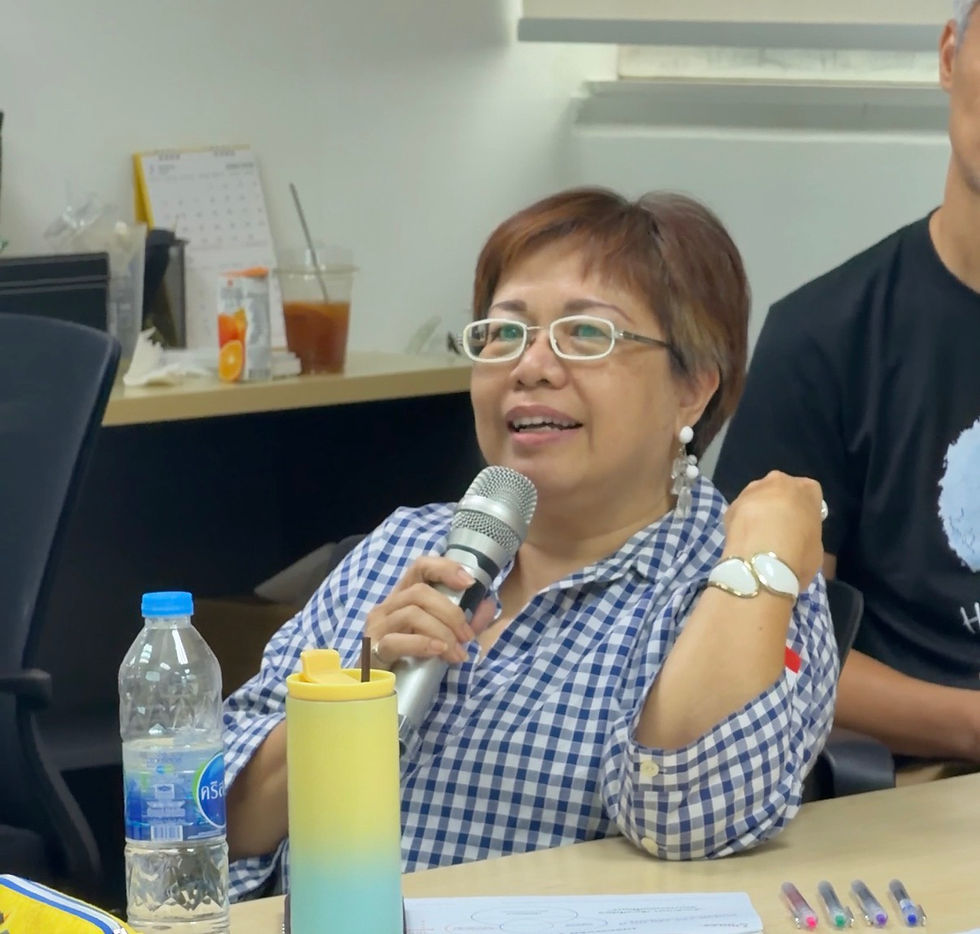
It felt like learning the 'Three Kingdoms' in a corporate edition. I learned how to 'know the enemy and know yourself,' and gained a more 'bird's-eye view' of work. Previously, I might have only focused on my immediate surroundings, but now I've returned to looking at people and situations more comprehensively. Another thing I liked is that we don't need to label anyone; just understanding where they stand and helping them take one step forward is a 'Small Win.' I also appreciated the details of the class and the organizing team—the slides were beautiful. It was a class that felt truly excellent.
After taking the class, I realized that when I have to talk or deal with someone, I can look through the '7 Roles' to understand where they stand and choose a better way to communicate or approach them. It allows me to see the situation more comprehensively than before. Another thing I liked was the atmosphere in the room, which included a diverse group of people, allowing me to listen to opinions and perspectives from many others. From initially not knowing what to ask and mostly just listening, as I gradually learned and checked each circle, I understood much more.
What impressed me most was the initial discussion about who fits which role, as it showed that everyone has different perspectives. I feel this class teaches about people in great depth. Personally, I have studied human behavior and psychology before, but it was mostly theoretical and based on examples. This class, however, allowed us to actually engage and dive deep, opening the floor for questions. Everyone shared their own experiences—both situations they've faced and people they've worked with—which helped us learn about people from a much wider range of perspectives and experiences.
I have always enjoyed learning about people, and what I like most are the three circles: Power, Legitimacy, and Urgency. In my work, I encounter many different types of clients. This framework helps me see that if there is a specific goal, I can understand and approach each person in a way that gradually moves them in the same direction as the desired goal. I feel this is something that can be greatly applied to my work.
Manoch Lertsakornsiri

Sudawan Wattanapong


Phonojun Jarurangsipong
What I like most is the See–Feel–Need framework because it allows me to practice looking from the other person's perspective—what they feel, what they need, and what concerns are holding them back. For me, what I must constantly learn is how to know people, to look from their perspective rather than my own, to feel as they do rather than as I do, and to discern what they are thinking about.
There are two key takeaways from this class. First, it made me rethink whether I really need to change this person. If they don't want to change, there's no necessity to change them, and since I can't change them, I might instead change myself. Second, if it's someone I truly need to drive change for, I used to just know that I wanted them to change without knowing how. When I couldn't do it, I felt frustrated. But now, I see that there is a method. I need to view them correctly and understand what they need, which helps me see a path to making change easier.
What I learned today is to reflect on how our actions impact others, both positively and negatively. If we do not consider those affected, it can impact their feelings and needs. This highlights why we must understand individual differences and roles in order to choose the right strategy and approach for each person. I believe this can be applied to everyone, regardless of their profession.