.png)
What are the 7 Roles of Change™? Understanding the 7 roles of people in bringing about change.

Updated: 5 hours ago
When organizational change occurs, people may respond differently. Some are ready to move forward, some are waiting and watching, some are asking questions, while others believe the change needs to happen immediately.
This is why change management is not just about plans or processes, but also about understanding the stakeholders involved in the change.

7 Roles of Change™ helps us see that people in the change process may have different roles, considering three key forces: Power, Legitimacy, and Urgency, leading to seven roles that require different approaches.

1. Sleeping Giant — Those in power remain silent.
A sleeping giant is someone who has power or authority over a particular matter, but doesn't yet see the importance or necessity of acting on it.
That's why you might hear phrases like, "We'll talk about it later, not now." Working with a sleeping giant isn't about rushing or pressuring them, but rather helping them see the value, relevance, and consequences of inaction in order to create awareness of that change.

2. Dominant — The influential one.
Dominant possesses both power and legitimacy; they have the authority and involvement in the matter, and therefore can support, approve, or pave the way for change to occur. However, the urgency may not yet be sufficient.
The key to working with Dominant is connecting change to the organization's strategy, risks, or priorities, so that it's clear why this should be happening now.

3. Observer — A person who waits and sees what happens.
An observer has legitimacy or is involved in the matter, but still needs information and to consider the situation before making a decision.
Instead of rushing observers to take sides or act hastily, we can create space for them to participate, see the data, and have the opportunity to make their own decisions on some issues, gradually building confidence in the change.

4. Dangerous — The Challenger
Dangerous combines both Power and Urgency. It has the power to move things forward or halt them, and there's a sense of urgency to the issue, but one might not agree with the direction of the change.
Outward appearances may be questioning or resisting. Working with Dangerous should begin with listening to the underlying concerns, creating space for dialogue, and seeking solutions together, rather than confrontation or trying to win.

5. Catalyst — The driver/provider
Catalyst possesses the power, legitimacy, and urgency of a person, making them ready to take action, coordinate people, and help drive change forward.
This role isn't just about making things happen on its own, but also about partnering in scaling up and helping others get involved in the change more.

6. Seeker — A person who seeks support.
A seeker possesses both legitimacy and urgency; they are directly involved in the issue and see the need to act, but may lack the authority, resources, or support necessary.
Working with Seekers, therefore, should involve providing them with the necessary tools, resources, and support so that their energy and intention can be translated into action, while being careful not to overwhelm them with the change they are carrying.
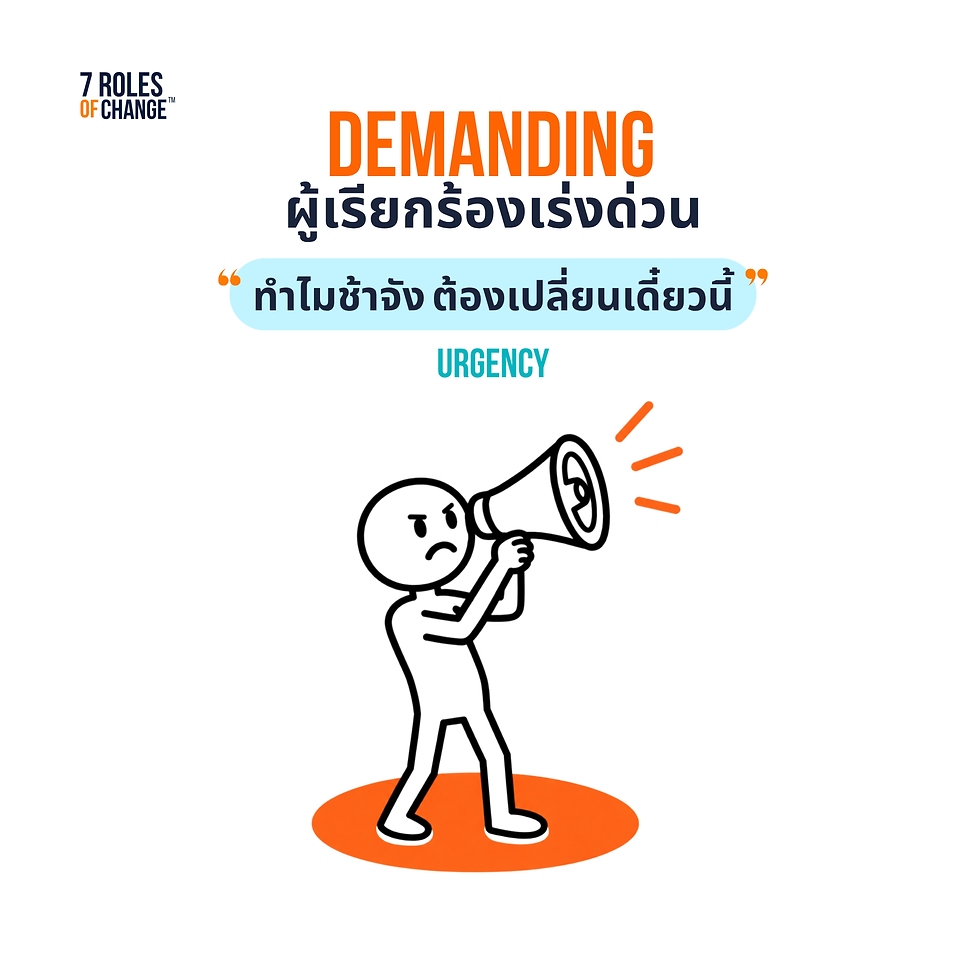
7. Demanding — Urgent demander
Demanding individuals have a high degree of urgency, viewing this issue as important and needing immediate attention, but may not yet possess sufficient power to drive change on their own.
Instead of viewing the demands as a problem, we can listen to what they are pointing out and help transform that urgency into concrete steps or actions.
7 Roles is not about labeling people.
The core message of 7 Roles of Change™ is that roles are not personalities. A single person can change roles depending on the situation and the time. Therefore, what we need to read isn't "what kind of person is this?" but rather, what role are they playing in this particular situation?
When we have a clearer understanding of roles, we can choose ways to communicate, collaborate, and manage stakeholders that are more appropriate to the situation, rather than using the same approach for everyone.
Because managing change in an organization isn't about making everyone think alike, but about understanding differences and knowing how to work with people in different roles.


Comments